.svg)

Lateral movement turns a minor incident into a major problem. What most teams miss is that it doesn't necessarily require malware or exploits. Successful breaches exploit trust, which we give to RDP, SSH, Telnet, PowerShell, and WinRM sessions once they're authenticated.
The protocols themselves aren't the issue; it's the assumption that everything inside the session is legitimate.
That's the assumption Keystrike eliminates. And here's how you explain it to your team.
Protocols Aren't Dangerous, Assumed Trust Is
To tackle the problem, we apply MFA, PAM, and a SIEM to help validate identity or log behavior. But none of them ask the most important question at the moment of execution: Was this action initiated by a legitimate, authorized person?
You can authenticate an identity at a point in time, restrict access to a subset of systems, and monitor what happens during a session. But none of that prevents a script from issuing its own commands once a session is active.
The largest attention in cybersecurity tools focuses on defenses around perimeter entry and session visibility. Keystrike shifts the control plane to the point of action, where commands happen. It validates that every command originated from real human input on a trusted device.
Where the Attacker Moves and How They Fit In
Attackers have adapted to use everyday admin tools to move laterally. If you've worked an incident, you've seen these tools used repeatedly:
| Protocol | Real Use Case | Typical Misuse |
|---|---|---|
| RDP | Remote support, shared workstations | Ransomware deployment, remote control, or session hijack |
| SSH | Secure remote access, system administration | Key theft, scripted data exfiltration |
| Telnet | Legacy systems, embedded devices | Internal pivoting, clear-text attacks against legacy equipment |
| PowerShell | Automation, domain management | LOLBins (Living Off the Land Binaries), fileless payloads |
| WinRM | Admin scripting at scale | Stealthy command relays, session hijacks |
Attackers simply reuse trusted channels rather than relying on custom binaries and libraries. All they need is a foothold and credentials, or even just a valid session to reuse. The attack chain continues because the protocols don't challenge the source of the input.
What Your Tools Catch And What They Miss
Let's walk through each protocol and see what standard tooling sees, and what it misses without attestation.
RDP – Remote Control or Ransomware Launchpad?
Scenario: An attacker logs into an exposed IT support machine via reused credentials.
| What Security Tools Log | What They Miss | What Keystrike Blocks |
|---|---|---|
| Session start time, user | Remote control via malware | Commands issued without human input |
| IP, Geo, Device ID | Recon and pivot actions post-login | Lateral staging tools like net use |
cmd.exe /c whoami && net use \\finance-server\C$
If no physical keystroke backs that command, Keystrike blocks the command and signals the intrusion in real time.
SSH – The Script That Looks Like You
Scenario: A script uses stolen SSH keys to exfiltrate data from a production host.
| What Security Tools Log | What They Miss | What Keystrike Blocks |
|---|---|---|
| Key authentication, login time | Script-driven automation using valid keys | Any shell command without attested input |
| Connection to target host | Command chaining in scp or rsync | Ghost sessions and scripted pivoting |
ssh engineer@10.0.0.15 "scp -r /srv/configs/ /tmp/.leak/"
Without attestation by Keystrike, the command is dropped at attempted input, because no one typed it.
Telnet – The Forgotten Attack Vector
Scenario: Telnet remains enabled on a network printer or piece of specialized equipment. An attacker scripts a connection to get access.
| What Security Tools Log | What They Miss | What Keystrike Blocks |
|---|---|---|
| Maybe raw traffic | Outbound commands from compromised firmware | All unauthenticated, non-human Telnet usage |
Keystrike also helps to close legacy gaps without needing to re-architect them, just attest and enforce physical input at the bastion hosts or jump boxes.
PowerShell – Post-Exploitation Pipeline
Scenario: A malicious session launches an obfuscated PowerShell for recon.
| What Security Tools Log | What They Miss | What Keystrike Blocks |
|---|---|---|
| Base64-encoded payloads | LOLBins, stealth post-auth exploitation | Fileless commands without physical attestation |
| Script execution timestamps | Commands sourced from malware or remote tools | Red team command chaining |
powershell.exe -EncodedCommand SQBtAG...==
You need to somehow detect the illegitimate use and signal to your endpoint detection or SIEM/SOAR platform if the real person was not behind the action.
WinRM – Silent but Deadly
Scenario: Lateral movement using WinRM within a domain-controlled environment.
| What Security Tools Log | What They Miss | What Keystrike Blocks |
|---|---|---|
| Session creation events | Remote pivoting via automation | WinRM session commands without HID backing |
| Target system responses | Command execution from hijacked sessions | All stealth channel usage |
You need to validate whether remote scripting tools like WinRM are being driven by a real operator or by malware post-compromise. Without that check, your automation surface becomes your blind spot.
Why Traditional Defenses Fall Short
You've likely deployed these controls:
- MFA verifies identity at a point in time, but not who's using the resulting session.
- PAM scopes access, but can't block misused credentials.
- SIEM logs and analyzes activity, but doesn't give us a clear signal until too late.
None of these controls challenge whether the original, authorized human is actually issuing the commands. Once inside a session, the attacker's commands become indistinguishable from the real user's. Almost.
You don't need another alert. You need a control that says: "If my user didn't type it, take immediate action."
Keystrike: Human Signal or No Execution
Keystrike attestation validates that a command came from a trusted input device operated by a real user. No signal? No action. We enforce input-level intent, not behavior-based inference.
Keystrike Can Detect and Terminate:
- Remote command execution via scripts
- Lateral movement using legitimate credentials
- Fileless malware leveraging native tools
- Post-auth hijacks and ghost shells
Keystrike Validates and Allows:
- Fully verified, physically typed sessions
- Admins to use their tools without risk
- Zero friction in dev, IT, or security workflows
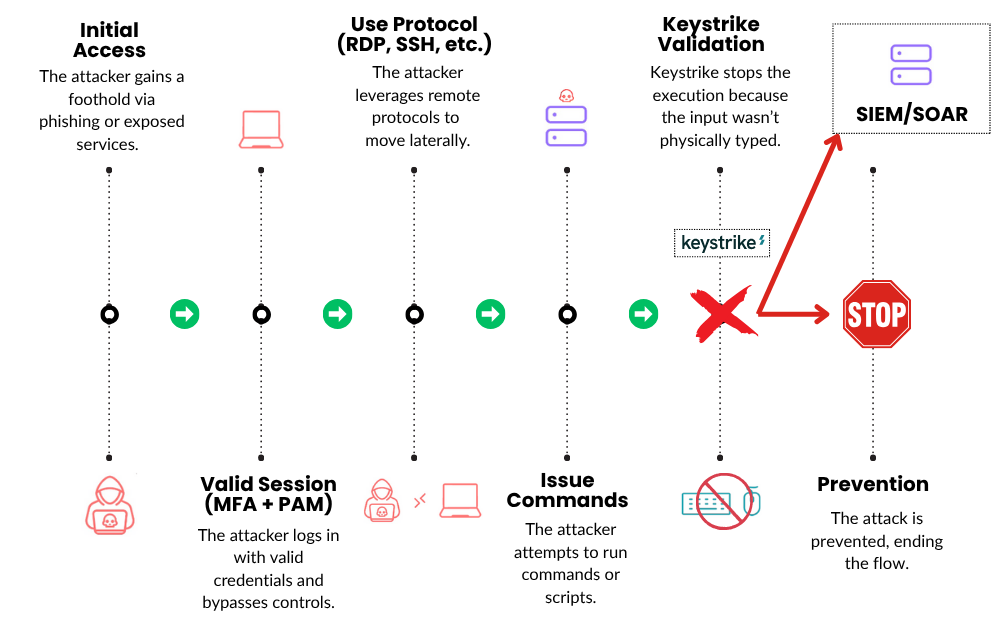
Keystrike protecting your workflow
Closing the Gap That Keeps You Up at Night
You don't lose sleep because a user clicked a phishing link. You lose sleep because you don't know what happened after the attacker got in. You've locked down accounts, segmented networks, enforced MFA, and tuned your SIEM. But you still ask: What if they're already inside? What if they're using my tools against me?
Keystrike is here to solve that question. It doesn't guess and correlate. It enforces the one truth that matters: commands must come from a real human, at a real keyboard, on a trusted device. If that chain breaks, the command never executes.
That's not visibility. That's control. You don't need another alert. You need to end the attacker's story before it begins. And now, you can.